Imagine two Pokémon TCG Pocket players looking at the same problem: their strongest attacker needs Energy. One puts Dialga ex to work preparing a teammate. The other builds towards Palkia ex’s big attack, then has to plan how to recover the Energy it spends. The two legends make an excellent introduction to a question that matters in every battle: what will your team be able to do on the next turn?
Dialga and Palkia headlined Space-Time Smackdown, released on 30 January 2025. The expansion brought Sinnoh into Pocket, with familiar Pokémon and cards that changed how a team could be prepared. Its most useful lesson for a family learning the game is still wonderfully concrete: read the attack, count the Energy and picture the board after it happens.
Sinnoh’s legends give the expansion its two faces
Dialga and Palkia come from the region associated with Pokémon Diamond and Pokémon Pearl. Their presence makes the expansion recognisable before you read a card: a child who knows Sinnoh can spot its legendary pair, then look for other familiar faces such as Lucario and Darkrai.
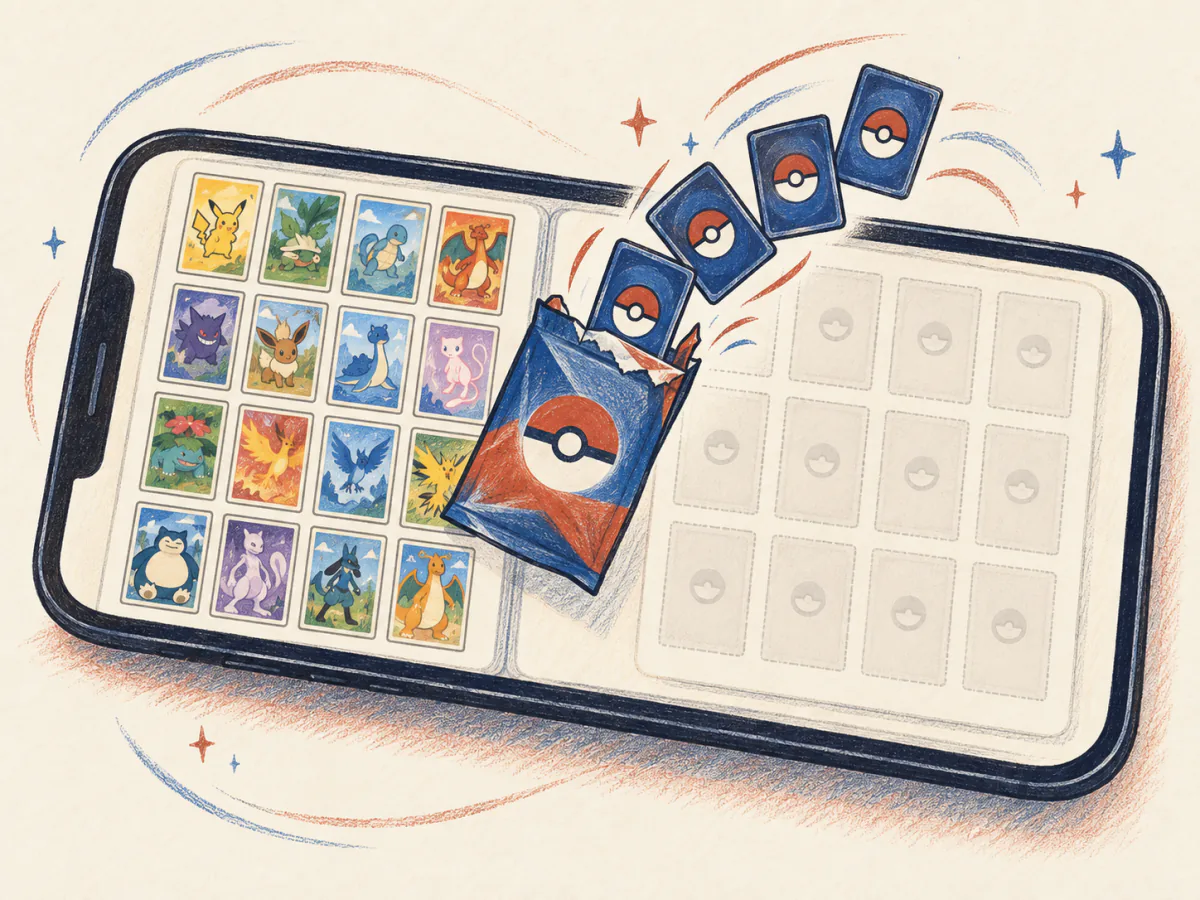
Pocket is the digital card game played on a phone or tablet. Opening its packs adds cards to the app’s collection; you then choose which ones to bring into a deck. The pleasure of finding a favourite Pokémon and the pleasure of making a deck work can overlap, but they ask different questions.
For collecting, the question might be which illustration you would like to keep looking at. For playing, it becomes what that card needs around it. A favourite legend can give you a starting point. Reading its attack and effect tells you what the rest of the team should help it do.
That makes a useful conversation with a child: “What do you like about this Pokémon?” followed by “What does its card do?” The first answer belongs to the fan. The second opens the game.
The official French-language launch trailer shows the two pack designs and the featured cards. Around 0:10–0:25, look for Dialga ex and Palkia ex. This is the January 2025 announcement; its trading information belongs to that date.
::youtube{id="Ev7-qCSnGgQ"}
For a paper activity alongside the cards, choose a Dialga or Palkia colouring page and compare the two silhouettes before picking your colours.
Dialga ex prepares an attacker while it fights
Metallic Turbo, Dialga ex’s attack, attaches two Metal Energy from the Energy Zone to one of your Benched Pokémon. Its distinctive contribution is the preparation happening alongside the attack. You can put Energy on a teammate that will matter later.
Take an illustrative situation: the chosen Pokémon on your Bench needs three usable Energy for the attack you want. You have already attached one. The two supplied by Metallic Turbo bring it to three, provided those Energy meet the attack’s requirements. You have turned this turn’s action into a possibility for the next one.
The decision is therefore about the whole team. Which Pokémon receives the Energy? Will you be able to bring it into the Active Spot? Does its planned attack actually suit the opponent in front of you? Preparing an attacker is more rewarding when you know what job it will take over.
Look at the teammate before choosing the attack. This is a lovely small lesson in planning: the Pokémon waiting at the back of the board can become the most important part of the turn. A child can explain the choice in a sentence: “I’m getting this one ready because I want to use it next.”
Palkia ex makes you budget for the following turn
Dimensional Storm deals 150 damage to the opposing Active Pokémon and 20 to each opposing Benched Pokémon. It requires three Water Energy and one Colorless Energy, then discards three Water Energy from Palkia ex. That gives the attack both its reach and its cost.
Here is a simple way to read the spread. With two opposing Pokémon on the Bench, the listed damage amounts are 150 + 20 + 20: 190 damage distributed across three targets, before other effects. The Active Pokémon receives the large hit; the two waiting behind it each receive a smaller one. Adding the amounts helps you understand the reach, while keeping their distribution visible.
Now look at your own Palkia. After the attack, the discarded Energy changes what it can do next. You need a plan for preparing another attack, switching to a teammate or responding to the opponent’s move. The satisfying moment is knowing what comes after the big number.
When playing together, pause before selecting Dimensional Storm. Ask which opposing Pokémon will be affected and which Energy will remain on Palkia. You are giving the child a way to think through the move, rather than simply pointing to the largest damage figure.
Lucario shows why a small bonus can be decisive
Space-Time Smackdown’s Lucario offers another kind of help. Its Fighting Coach Ability adds 20 damage to attacks used by your Fighting Pokémon against the opponent’s Active Pokémon. Lucario can support the team from the Bench.
Suppose, for an illustrative calculation, that a Fighting attack would deal 80 damage to an opposing Active Pokémon with 100 HP remaining. With the 20-damage bonus, that becomes 100 before other effects. A modest-looking addition reaches the amount needed in that particular situation.
This makes Lucario useful for explaining how to read a board. Compare the damage you can deal with the HP remaining on the target. Then ask which cards change the calculation. The best move may involve preparing support before attacking, rather than choosing a different Pokémon with a more dramatic picture.
The same habit helps when looking through a collection. A card’s job might be attacking, preparing Energy or supporting another attacker. A good teammate can be a favourite for what it makes possible. It is a different way to enjoy the cards, especially for a child who initially notices only the biggest legend.
Learn a plan with the cards you already have
You can explore these ideas without trying to collect every version of the expansion’s stars. Look at the cards already available in your collection and choose one action to understand: preparing a teammate, spreading damage or reaching an exact damage total.
Before a friendly or solo battle, describe the plan in plain words. “I want to prepare this Pokémon while another one attacks” is a more useful starting point than a list of impressive names. After the battle, look for the turn when the plan worked or became difficult. Was the right Pokémon ready? Could you get it into position? Had you counted the cost of the previous attack?
If you want to exchange cards, use the app’s current trade information. That system has changed since Space-Time Smackdown launched; an old announcement belongs to the game’s history. For this learning exercise, the important thing is identifying the card and the role you are seeking, then deciding with the family whether it is worth pursuing.
You can even keep a tiny battle notebook: one plan, one useful turn and one thing to try differently. It turns a loss into a specific observation and a win into something you can explain.
Before your next attack, point to the Pokémon you want to use on the following turn. Check its Energy, its position and the job it will do. Dialga ex and Palkia ex become much more interesting when the legend on the card leads to a plan you can actually play.