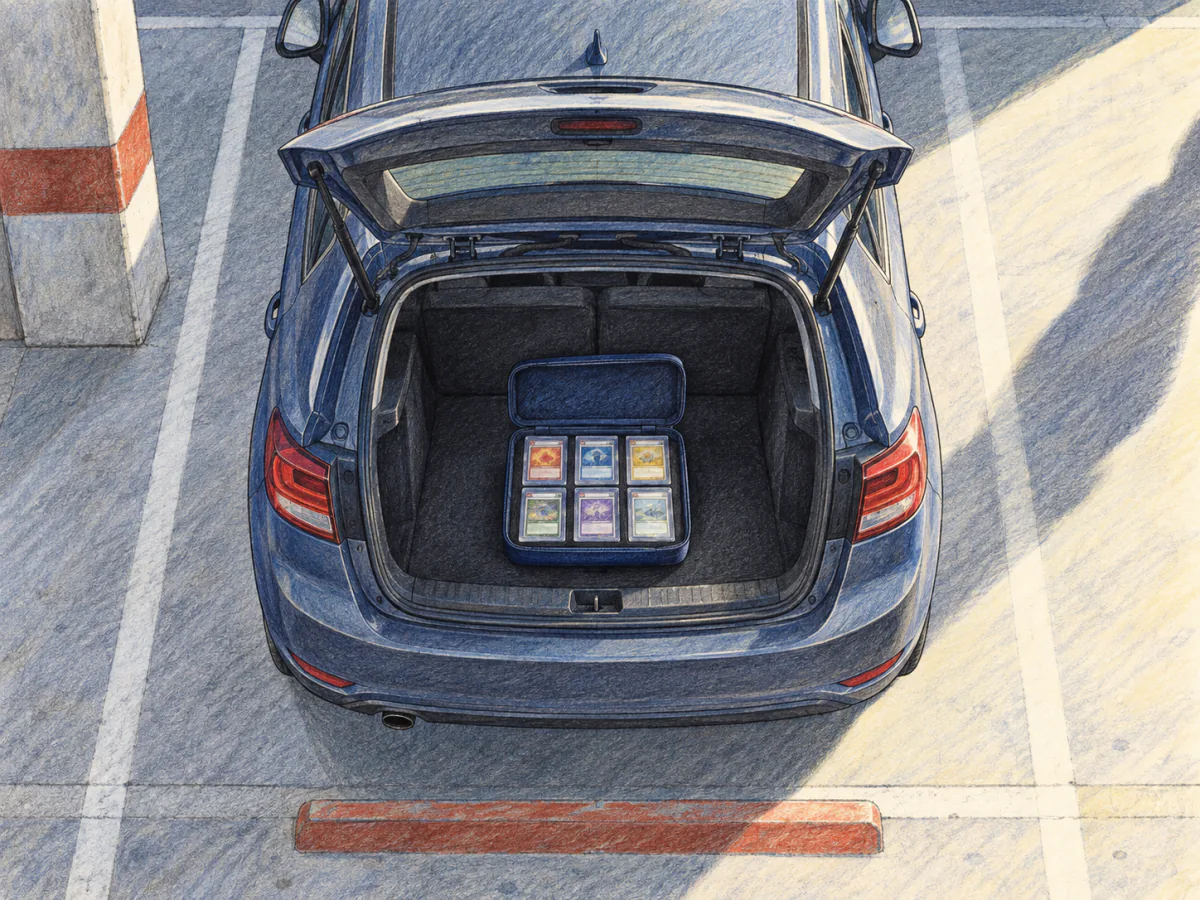
The theft that occurred during the 2025 TCG Kingdom event sent shockwaves through the community: a car was stripped of more than 40,000 euros’ worth of graded cards, right in the heart of Paris, with no apparent signs of forced entry. The case was all the more striking because it was solved thanks to the vigilance of a collector from Metz who spotted suspicious online listings. Behind this almost cinematic tale lies a deeper problem: Pokémon cards have become such lucrative commodities that they now attract organized thieves, transforming a nostalgic hobby into a high-risk market.
Thefts are on the rise in stores, at conventions, and even during transactions between private individuals. Certain events, such as Belgium TCG 2025, have also been marred by the disappearance of graded cards in a matter of minutes.
Far from being mere anecdotes, this trend is now mapping out a veritable criminal network surrounding the card market.
And to understand why, we must examine what a simple cardboard card is worth today… and what that reveals about our times.
The Iconic Heist at TCG Kingdom 2025
A Targeted Operation in the Middle of TCG Weekend
At TCG Kingdom 2025, the thieves didn’t act at random. The Saint-Germain-des-Prés underground parking garage offered them the perfect setting: discreet, busy, and full of collectors carrying cards whose value easily exceeds that of many of the cars parked around them.
In the case of the victim from Gironde, the absence of forced entry suggests a sophisticated lock-picking technique.
The targeted cards? Graded ones, specifically those whose authenticity and condition are certified —in other words, those that resell quickly and for (very) high prices.
The timing was no coincidence: during a TCG show, collectors often bring their finest pieces to display, sell, or have them graded.
Cars become rolling safes… but without locks worthy of the name. Thieves know this all too well and take advantage of the exceptional concentration of high-value inventory.
In this case, the stolen PSA and CGC control modules represented an ideal windfall: compact, recognizable to enthusiasts but not traceable enough to deter unscrupulous fences.
Resolution Thanks to the Community
If this case left a lasting impression, it’s mainly because it ended with a small miracle: the community did the work that many criminals still underestimate.
Upon learning of the theft, a collector from Metz immediately noticed suspicious online listings offering cards far too rare to have appeared by chance.
In a market where some items exist in only two copies nationwide, the inconsistency is obvious to regulars much faster than it is to law enforcement, and that vigilance quite simply turned the situation around.
What followed was almost like a scene from an amateur film, but with PSA 10 cards as the treasure.
The collector from Metz set a clean and precise trap: he made contact with the sellers, feigned interest during negotiations, and then immediately alerted law enforcement.
The meeting arranged near the Nancy train station allowed the BAC to apprehend the suspects and recover a large portion of the loot.
This extremely rare success serves as a reminder that the community is a network of experts capable of identifying an anomaly faster than a thief can hide his loot.
A Series of Incidents Revealing a Major Trend
The Royaume TCG case is not an isolated incident in the market; it is part of a series of incidents that clearly point to a trend.
Burglarized stores, collectors attacked, packages diverted at sorting centers… examples are multiplying throughout France.
Even major events are no longer spared: during Belgium TCG 2025, graded cards disappeared in a matter of minutes during setup.
Conventions have become hunting grounds for those who know where to look. This is therefore no longer an isolated problem but a criminal trend that is taking hold.
Why Do Pokémon Cards Attract Thieves?
A Market That Has Become Extraordinarily Lucrative
The boom in the Pokémon card market has profoundly changed the way they are perceived.
Long considered a niche hobby, they have become, in the space of a few years, a true speculative asset.
The numbers speak for themselves: more than 10 billion cards printed annually, international growth of nearly 10% per year, and sales skyrocketing both in stores and on online marketplaces.
In France, the sector is now worth over 180 million euros annually, driven by unflagging demand, modern editions that sell out in a flash, and a massive craze for graded cards.
At the high end of the market, some cards fetch prices worthy of country homes.
The Pikachu Illustrator, which has soared to several million dollars, paved the way for a new perspective: that of a cultural product turned financial commodity.
Base Set Charizard, Gold Star Rayquaza, Neo Genesis Lugia… these are names that now set the hearts of investors racing just as much as those of fans.
And when an object weighing just a few grams is worth more than its weight in gold, it automatically becomes a prime target for all forms of opportunistic or organized crime.
This phenomenon is reinforced by the rise of grading: by encapsulating a card and assigning it an objective grade, PSA and other companies in the sector have created a standard that transforms an object of sentimental value into a liquid financial asset. A PSA 10-graded card can be worth ten, twenty, or sometimes fifty times more than its “raw” version. For thieves, this difference represents a compact jackpot that’s easy to carry and simple to sell. For collectors, it marks the beginning of a new level of vigilance: every highly-rated card is no longer just valuable— it’s coveted.
Small size, high value: the perfect combination
From a strictly logistical standpoint, a Pokémon card is a thief’s dream.
It’s a tiny, ultra-light, inconspicuous object—and yet sometimes as profitable as a piece of jewelry or a luxury watch.
Just a few dozen graded cards can be worth tens of thousands of euros—all of which fit into a single backpack.
Where other valuable goods require vehicles, accomplices, or at least some handling, Pokémon cards can slip anywhere—into a pocket, under a coat, or behind a poorly guarded display case.
The disparity between volume and value is so disproportionate that it creates a genuine loophole in risk management.
Furthermore, the cards leave no trace and make no noise.
No laser-engraved serial number like on a watch, no mandatory certificate, no reporting requirement.
Some graded cards do have an identification number, but all a thief needs to do is destroy the case to make the card unrecognizable and difficult to link to the theft.
In the case of ungraded cards, it’s even worse: two identical copies are indistinguishable without very specific characteristics. This lack of physical constraints creates a perfect environment for criminals, who can steal extremely valuable items withouthaving to deal with technical complications.
Finally, unlike other, bulkier collectibles such as LEGO sets, figurines, or certain sealed booster packs, cards have no cumbersome “physical presence”. A thief can disappear into the crowd at a convention in a matter of seconds or leave a parking lot without attracting attention. You don’t carry a masterpiece under your arm, but you can easily slip a PSA 10 Rayquaza Gold Star into a hoodie. It is precisely this simplicity—almost absurd given the values at stake—that makes this criminal phenomenon so explosive today.
Reselling Is Too Easy
What ultimately turns Pokémon cards into a thief’s paradise is the baffling ease with which they can be resold.
General-purpose platforms—Leboncoin, eBay, Facebook Marketplace—function like highways where thousands of listings pass through every day.
There is absolutely nothing stopping a fence from creating a brand-new account, posting a few cards at “attractive prices,” and disappearing once the transaction is complete.
Identity checks are limited, moderation is often passive, and prices that are too low irresistibly attract buyers in a hurry. Fencing the stolen goods doesn’t require a structured criminal network to work —just a smartphone.
For graded cards, the situation isn’t necessarily any better. The certification number could serve as a tracking tool, but it is far from being systematically checked by buyers.
And when a thief decides to break open the case to resell the card in its “raw” form, any trail vanishes instantly.
In some cases, this damage causes the card to lose some of its value… but it retains enough to make the operation profitable. Theft is no longer confined to traditional crime; it is part of a fluid, digital, and largely unregulated market.
As for ungraded cards, they are nearly impossible to identify once they’re out in the wild. Even the most seasoned collectors can only spot a stolen card if it has a very specific mark. And since thieves know this, they often prioritize volume: many recent cases involve hundreds or thousands of stolen cards sold in bulk, then resold in lots as “heirloom collections” or “attic clear-outs.” In a market where supply and demand are so dynamic, fencing literally blends into the background. The crime no longer even needs to be discreet, since it simply camouflages itself within the flow.
Thieves’ New Methods
Burglaries of Specialty Stores
Burglaries of specialty stores have become one of the most striking features of this new generation of crime.
Thieves are no longer amateurs looking for an easy score: they arrive equipped, organized, and, above all, very well-informed.
In several recent cases, the same pattern emerges: a nighttime break-in, a signal jammer to disable the alarm, precise targeting of display cases holding the most expensive cards, and a getaway in less than ten minutes. The theft has become a surgical operation.
A store manager in Maine-et-Loire recently recounted that the criminals “entered through the back to remain discreet,” a sign that they knew the premises and their blind spots inside and out and had conducted a reconnaissance.
Speed is their greatest weapon. In a typical retail store, valuable items are scattered throughout; in a card shop, they’re grouped together in a few display cases, sometimes within easy reach. Stealing 80,000 euros’ worth of cards therefore requires neither a truck nor complex logistics: just a few bags and a bit of daring. Stores that haven’t reinforced their display cases with laminated glass or multi-point locks become ideal targets, since these heists ultimately take only two minutes longer than a typical tool theft.
This trend is making these stores increasingly similar to jewelry stores. Some retailers have already sounded the alarm: for them, selling Pokémon cards is now akin to displaying items as coveted as gold coins.
Storefronts must be reinforced, alarm systems doubled, and video surveillance overhauled to match that of a luxury retailer. For while the cards have long been considered “fun” products, their current value demands a security infrastructure that is anything but child’s play.
Ambushes and Assaults During Meetups
Meetups between private individuals, long considered a friendly pillar of the community, have become one of the biggest security risks.
Many collectors still prefer to avoid platform fees or simply want to examine a card before buying it… which leads them to arrange meetups that can sometimes be risky.
These exchanges, often arranged through classified ads, provide the perfect setting for thieves: an isolated location, a collector focused on the item, and cardsworth as much as several thousand euros. Several recent cases show just how quickly this scenario can turn sour in a matter of seconds.
In Grenoble, for example, two men set a trap for a collector who had come to sell cards estimated to be worth between 5,000 and 6,000 euros.
Violence, intimidation, a quick getaway: the operation looked more like an impromptu robbery than a simple scam.
Other cases are even more brutal, with some collectors having been attacked in their homes after naively sharing too much information online. When thieves know exactly what they’re coming for— and how much it’s worth — the encounter is no longer a transaction; it’s an ambush.
Collectors all too often underestimate the risk, convinced that “it only happens to other people.” However, thieves don’t just target extraordinary collections; they also go after mid-range lots, which are easy to sell and less closely monitored. Every in-person meeting should be viewed as a risky transaction, just like selling a smartphone or jewelry. The card market has grown, but its practices haven’t kept pace.
Vehicle Theft and Internal Theft
Between events, transactions, or grading sessions, many collectors transport cards in their vehicles that are sometimes worth more than a new sedan. For thieves, these cars represent a rare opportunity: a high-value asset, parked in an isolated location, and most of the time protected only by a central locking system. In several recent cases, criminals have used non-intrusive opening techniques capable of discreetly unlocking modern vehicles. Receiving stolen goods literally begins in the parking lot.
A more discreet, but equally troubling, aspect involves inside theft: employees or contractors with access to the inventory of a store, distributor, or event organizer. In one of the most striking cases, a former employee of a major market player embezzled more than 100,000 euros’ worth of products, which were then sold at a massive profit. These thefts do not rely on force or trickery, but on privileged access. When handling cards that are sometimes worth thousands of euros each, the temptation is right at one’s fingertips, and surveillance is insufficient.
Internal thefts are particularly difficult to detect, as they are easily concealed within logistics flows or inventory errors.
Many companies in the sector simply have not adopted the control practices found in the luxury market.
Managers sometimes discover discrepancies several weeks after the fact, when the cards have already been resold.
For an insider thief, the advantage is twofold: they know which items are the most profitable and know exactly how to avoid cameras or records. This is the most insidious aspect of the phenomenon, and probably one of the most underestimated.
TCG Events
TCG events—trade shows, conventions, championships—have become high-risk hotspots. They bring together in a single location everything thieves love: thousands of high-value cards, quick transactions, crowded booths, visitors too busy to keep an eye on their bags, and a constant flow of people that obscures any attempt at identification.
For criminals, these events are like luxury markets… without the security of a luxury market.
Ironically, the setup and takedown phases are even more dangerous than when the event is open to the public. It is during these transitional moments that security is at its weakest and exhibitors handle their cards without any special protection.
The theft at the Belgium TCG 2025 illustrated this brutally: just a few minutes of inattention are enough for dozens of graded cards to vanish. Until organizers activate their cameras and security measures as soon as exhibitors arrive, this vulnerability will remain wide open.
Added to this is a phenomenon well known to collectors: in the hustle and bustle of a show, people naturally let their guard down.
Between impulse buys, trades, conversations, artist signings, and endless lines, no one can constantly keep an eye on every pouch or briefcase.
Thieves, on the other hand, have only one mission and quickly spot the collectors carrying the most items or the least well-organized booths. A theft can be committed in five seconds, slipped between two shoulders in a crowded aisle. The density of the crowd then becomes a perfect shield for making a getaway.
The Psychological Factors That Make Theft So Devastating
Why Collectors Are Vulnerable
Pokémon card collectors are particularly vulnerable not only because of the value of their collections, but also because of their behavior —often passionate, sometimes naive.
Many proudly share their finest pieces on social media, announce their acquisitions, or show the insides of their binders without realizing they’re unwittingly giving away valuable information: card types, quantities, condition, and sometimes even location.
For an unscrupulous thief, it’s an Instagram-style treasure map. What was once a harmless display has become a door left ajar to very real risks.
This vulnerability is exacerbated by the very nature of the hobby: collectors often travel with their cards, whether for sales, trades, product openings, or events. Some of them carry enormous valuables with surprising nonchalance, convinced that “everything will be fine” because the community seems friendly. This disconnect between the cards’ actual value and their owners’ perception of it creates a massive blind spot in managing their own security. A thief, on the other hand, has no trouble spotting someone walking around with a binder worth 20,000 euros.
There’s also the group effect to consider: at a convention or tournament, collectors feel protected because they’re surrounded by fellow enthusiasts, as if the community spontaneously formed a moral barrier against theft. In reality, this collective confidence reduces individual vigilance. Many set down their bags to flip through a binder, leave their briefcase behind for a few seconds, or walk away from a booth thinking they’re still in a “secure” area. It is precisely this overconfidence —more than the value of the cards—that creates the gaps thieves rush through.
An Emotional Impact Worse Than the Financial Loss
What thieves don’t understand—and probably never will— is that market value is just the tip of the iceberg. A Pokémon card collection, especially one that has been patiently built up over the years, carries considerable emotional weight. Many collectors speak of their cards as a “personal legacy,” a tangible link to their childhood or their history. When a collection disappears, it’s an intimate timeline, a tangible memory, that vanishes. For some, losing a Charizard is less painful than losing a card from a memorable trade on the playground.
This emotional dimension explains why victims of theft often describe a shock far more intense than expected.
Anger, shame, and the feeling of betrayal add a series of psychological wounds to the loss that have nothing to do with money.
The collector feels stripped of a part of themselves, as if an inner space had been shattered. This is a phenomenon psychologists know well: when our possessions embody moments in our lives, their disappearance creates a void that goes far beyond the object itself. In the case of Pokémon cards, this emotional bond is exponential, as it often ties into childhood and nostalgia.
This emotional intensity also explains the tremendous mobilization of the community in cases like that of the TCG Kingdom. We’re not just defending pieces of cardboard; we’re defending the passion, the memories, and the legitimacy of the hobby. When a thief steals a collection, they’re attacking an entire cultural ecosystem. Hence the often very rapid reaction—and sometimes more effective than that of the authorities—from a community that categorically refuses to let its world be tainted by criminality. In this collective struggle, emotional attachment becomes a form of armor… and a driving force for solidarity.
How to Protect Your Collection in 2025?
For Collectors
The first step to take—as simple as it may seem—is to turn down the flow of online information a bit.
Showing off your cards on Instagram or detailing your collection on Facebook may seem harmless… until a malicious individual scours your profile like a catalog.
Modern thieves no longer just prowl the streets: they scroll, they scrutinize, and they take notes.
The best defense, therefore, is to limit overly detailed photos, avoid mentioning your location or how your collection is organized, and only share publicly what you’d be okay with losing.
For those who own valuable cards, investing in a fireproof, drill-resistant safe is no longer an extravagance.
The most expensive graded cards can be stored there, while less valuable binders can be kept in less accessible rooms.
Combining this with an alarm system, a few indoor cameras, and a properly reinforced door can transform even a vulnerable home into a reasonably secure fortress.
Security doesn’t have to be spectacular to be effective—it simply needs to make the task difficult enough to deter opportunists.
When it comes to buying or selling between individuals, one simple rule can help you avoid 90% of the trouble: never leave anything to chance. Choose public, well-lit, and busy locations; stay in areas covered by security cameras; avoid cash, and always check the seller’s or buyer’s reputation. If someone insists on meeting “at their home,” “in a secluded parking lot,” or “late at night because they have no other choice,” that’s usually a red flag flying high.
Many collectors overlook this essential step: keeping a complete inventory of their cards.
Clear photos, PSA or CGC grades, invoices, receipts, purchase dates… These details aren’t just useful in the event of theft; they also facilitate reimbursements, insurance claims, or legitimate resale. A well-maintained digital file can make all the difference between a thorough investigation and a simple “sorry, there’s nothing we can do.”
For Stores
Specialty stores no longer have the luxury of treating their display cases as mere showcases: they are now like jewelry boxes that must stand up to well-equipped thieves.
Laminated or tempered glass, multi-point locks, display cases bolted to the floor, and anti-pry systems are no longer options but prerequisites. When a break-in can be carried out in less than ten minutes, even the slightest weakness becomes an open invitation. A secure display case, on the other hand, often deters an attack before it even begins.
Video surveillance must be treated as a fully-fledged network, not just a gadget. Indoor and outdoor cameras, night vision, continuous recording, off-site backups… each element adds a layer of difficulty for criminals.
Combining these measures with a silent alarm and rapid response can turn a burglary attempt into a complete failure. Stores that handle high-grade cards should now adopt jewelry store standards, regardless of whether their storefront says “Pokémon cards” rather than “gold and diamonds.”
Storing all of your most valuable cards in the store after closing is no longer a viable strategy.
Ideally, part of the inventory should be moved daily to a bank vault or a secure off-site location.
Employees must be trained to recognize suspicious behavior, to systematically lock sensitive areas, and to follow strict closing protocols. A significant portion of recent thefts occurred during moments of complacency: a door left ajar, an alarm deactivated too early, inventory left accessible for a few minutes.
Retailers who maintain a healthy and transparent relationship with their community often benefit from an additional safety net.
A regular customer who notices something out of the ordinary, a vigilant neighbor, a collector who spots a suspicious card online...
The store isn’t isolated: it’s part of an ecosystem.
Without becoming paranoid, informing customers of the need to be discreet and vigilant—or explaining why certain security measures are in place—strengthens cohesion and makes the store less vulnerable.
For Event Organizers
Most thefts at events occur before the event opens to the public, while exhibitors are setting up their booths, which are still vulnerable. This is precisely where organizers must focus their efforts: cameras activated as soon as the first badge is scanned, systematic security patrols, monitoring the aisles during vehicle-to-booth trips... These simple measures close a gaping door that thieves have been exploiting for years. A TCG event is not “less dangerous” before opening—it is more dangerous, and must be treated as such.
Parking lots are one of the weakest links at any convention. They are filled with cars loaded with high-value items, often left unattended while owners carry a few boxes. A poorly positioned camera, a dark area, an unmonitored basement: these are all invitations to thieves. Organizers must install a truly active surveillance system: mobile security, high-definition cameras, clear signage, and even optional escorts for exhibitors carrying the heaviest loads. A well-monitored parking lot is often enough to deter opportunists.
Many exhibitors—even professionals— still underestimate the risks of a TCG event, convinced that “it only happens to other people.” In reality, simply providing regular updates—via emails, announcements, or morning briefings—can drastically reduce incidents. A reminder about discretion during transport, the importance of securing briefcases, or the value of an up-to-date inventory before arriving on site helps instill best practices. This isn’t a luxury—it’s basic prevention, but it has the potential to protect dozens of booths.
When a theft occurs, the minutes that follow are critical.
Organizers must have a clear protocol in place: blocking exits, immediately reviewing surveillance footage, stepping up patrols, alerting exhibitors, providing administrative support to the victim, and contacting law enforcement immediately.
The faster the response, the greater the chances of recovering the cards. Organizers who improvise waste precious time —exactly what thieves are counting on.
In a market where everything can disappear in five minutes, responsiveness is a weapon.
What changes can we expect in the coming years?
The market will continue to expand
All projections point in the same direction: the trading card market—and Pokémon in particular— hasn’t finished growing.
International studies predict double-digit annual growth through 2033, driven by the franchise’s global popularity, the arrival of new generations of players, and the ongoing inflation of sealed products.
Graded cards, meanwhile, are becoming the norm rather than a niche: for an ever-larger share of collectors, owning an expensive card without a sleeve is no longer just a choice—it’s almost an anomaly. The professionalization of the sector is automatically driving up the average value of collections.
This growth is also driven by the internationalization of the market. By 2025, a significant portion of French-language card sales will be directed toward the United States, Asia, or Northern Europe. Global trading platforms, price-tracking tools, and the popularity of unboxing videos have made the market global and virtually instantaneous. A card found at a flea market can be sold on the other side of the world that very same evening. This liquidity boosts the financial appeal—and thus criminal interest. The larger the market grows, the more its cumulative value attracts attention…and not just from honest collectors.
Finally, let’s not forget the “alternative investment” effect that is gradually taking hold.
More and more investors are diversifying their portfolios with Pokémon cards, drawn by their performance, rarity, and the relative stability of older cards.
When family offices and traders start buying Charizard cards the way others buy rare whiskey, it’s a clear sign that the market is entering a whole new dimension. And with this move upmarket, the total value stored in private collections is skyrocketing… which automatically fuels thieves’ interest.
Crime will likely adapt
As the market gains value, thieves’ methods are likely to become more sophisticated.
We’re already seeing the emergence of techniques inspired by professional burglary: signal jammers, non-intrusive entry methods, prior reconnaissance of schedules and routines, and exploitation of blind spots in stores or parking lots. It would be naïve to imagine that this shift toward higher-end targets will stop there.
If a PSA 10 Charizard is worth more than a gold bar, it stands to reason that certain organized groups will adapt their arsenal to target this new hunting ground.
The most concerning risk could come from digitally targeting high-value collectors. Many of them publicly display their rare cards, their grading progress, or entire binders full of vintage cards. All it would take is for a somewhat methodical thief to cross-reference these posts with other data (approximate location, habits, event attendance) to identify a specific target. This type of profiling already exists in other sectors such as sneakers, watches, or even classic cars: it would be surprising if it didn’t eventually reach the Pokémon market.
Another front may open up: that of counterfeits. Rising prices make it financially worthwhile to develop sophisticated counterfeits, some of which are undetectable without advanced expertise. Some scams that have already been observed rely on “modified” cards, counterfeit PSA sleeves, or imitation grade stickers. The criminals of tomorrow may not even need to steal anymore: they could simply manufacture cards that don’t exist. Collectors will need to develop a more critical eye and use more sophisticated verification tools.
Finally, there is a still-under-the-radar but plausible scenario: the use of cards as a vehicle for money laundering.
Their small size, high value, liquidity, and the lack of mandatory certification make them a potential vehicle for concealing money transfers.
Other alternative markets have followed the same path: art, rare whiskey, watches… There’s no indication that Pokémon cards will be spared if their value continues to rise.
In short, crime will become as professionalized as the market itself —a sad mirror image.
Areas for Improvement
The first necessary step involves traceability.
Today, when a graded card is stolen, information spreads through informal channels: Facebook posts, Discord messages, shared files. A European database listing PSA, CGC, BGS, or PCA numbers reported as stolen would be a major change.
Accessible to collectors, stores, and platforms, it would make it possible to block resale even before the item is listed online. Technically, this is entirely feasible: the industry simply lacks a shared commitment to getting organized.
Some grading companies are already exploring tamper-proof seal systems or NFC chips embedded in card sleeves.
The idea isn’t to turn every card into an electronic gadget, but to make reselling significantly more difficult.
Combining this technology with a blockchain could create a unique digital identity for each graded card —one that’s tamper-proof and accessible with a single click.
Nothing would then prevent a PSA 10 Charizard from being linked to a complete history, making it pointless for thieves to destroy the card case. A sort of “vehicle registration” for the Pokémon world.
In France, insurance for Pokémon cards remains chaotic: few guarantees, few products that are truly tailored to the market, and a general lack of understanding of the sector’s value.
Developing dedicated policies —as exists in the United States—would be a crucial step toward protecting collectors and stores. But this requires that the market be officially recognized as a distinct asset class. Ultimately, minimal regulation of high-value sales on platforms could also reduce the circulation of stolen goods.
Finally, one of the most accessible tools remains training. Law enforcement, event organizers, shops, and even collectors would benefit from developing a shared understanding of risks: how to recognize a counterfeit, how to detect suspicious behavior, and how to report a stolen card effectively. When a market reaches several billion, it is no longer just a hobby—and it deserves a level of prevention commensurate with its significance.
The theft that occurred during the 2025 TCG World Championship reflects a market that has changed in nature.
Pokémon cards have entered a realm where passion and speculation intersect, and where collectors—who were once carefree—must now think like owners of luxury goods.
Criminals understood this before anyone else, turning convention parking lots, store windows, and private transactions into their operating grounds.
But this phenomenon isn’t just about the greed of thieves; it also speaks to the maturity of a community capable of uniting, investigating, raising the alarm, and sometimes even solving cases that the police struggle to unravel. Collectors are protecting a culture, a legacy, and an emotional bond that has been woven over several generations.
The future of the market rests on a fragile balance: more security, more tools, more vigilance… without losing the joyful and passionate spirit that makes it such a unique world.
Pokémon cards are now worth a lot—but they mean even more. And that is precisely why it is essential to protect them, not only from greed, but also from the real world, which sometimes knocks a little too hard and unfairly on the door of this hobby.