Pokémon has long since left behind the monochrome screen of the Game Boy, where the adventure began in 1996. As it approaches its 30th anniversary in 2026, Pikachu and his friends have made their way from video games to notebooks, then returned to the family dinner table in the form of drawings and coloring pages. This circulation explains part of their longevity: each generation recognizes the same creatures but makes them its own with its own colors, techniques, and stories.
Pokémon’s 30th anniversary, therefore, celebrates more than just a commercial franchise. It offers a glimpse into how a popular universe becomes a shared language between adults and children. Drawing plays a subtle, concrete, and accessible role here: it transforms one person’s memory into a shared creation.
Thirty Years, Many Entry Points
Pokémon was born in Japan in 1996. For its 30th anniversary, the official campaign asks a deliberately simple question: “Which one is your favorite?” The campaign invites fans to choose a creature and share their answer. The announced events even distinguish between family-friendly gatherings and others aimed at fans who grew up with Pokémon. The coexistence of different generations is therefore no longer a side effect of the franchise—it’s an integral part of how its anniversary is being celebrated.
Not all adults discovered Pokémon in the same way. For some, their memories are tied to the early games or the animated series; for others, to trading cards, and later to Pokémon GO. Today’s children sometimes discover the franchise through a recent game, a video, or a printed sheet. No single medium can capture thirty years of history on its own. However, the silhouettes, colors, and names create enough shared points of reference to spark a conversation.
Drawing Transforms a Memory into a Shared Experience
Looking at an old card is an act of reminiscence. Drawing requires something else: observing, choosing, and interpreting. A parent might immediately recognize Pikachu’s ears or Charmander’s flame, while a child might notice a pose, an evolution, or a color discovered in a more recent game. The two perspectives don’t overlap, and that’s precisely what makes the activity interesting.
Adults Pass On Points of Reference, Not a Perfect Model
Sharing isn’t about flawlessly reproducing the official drawing. It can start with a very simple story: the first Pokémon chosen, a card traded in the schoolyard, or a creature drawn from memory. These memories give the character a personal history, without imposing on the child the “correct” way to depict it.
The pencil also bridges the gap between levels of knowledge. It’s not necessary to be an expert on types, generations, or the rules of the game. A circle, two ears, and a few colors are enough to get started. Our step-by-step guide to drawing Pikachu can serve as a starting point, but the result is best when it remains personal.
Children Reinterpret the Legacy They’ve Inherited
A child can change the colors, invent an evolution, or place a Pokémon in a setting that didn’t exist in the adult’s memories. This reinterpretation doesn’t betray the original: it keeps the universe in motion. Culture is rarely passed down as an exact copy. It endures when everyone can add something to it.
This idea helps distinguish collaborative drawing from mere nostalgic consumption. Buying a commemorative item leaves a trace. Creating side by side produces a new experience, linked to a moment, a discussion, and two ways of seeing the same character.
When Pokémon Enters the Museum
The exhibition A Legendary Exhibition, on view at the Musée en Herbe in Paris from April 16 to September 6, 2026, provides a very visible indication of this cultural evolution. The museum targets an audience “aged 3 to 103” and features, among other things, vintage cards, preparatory sketches from the animated series, and Pikachu’s evolution as depicted by various artists. The exhibition also includes guided tours and workshops that bring parents and children together around artistic creation.
This exhibition is an independent tribute, not affiliated with The Pokémon Company International, as specified in its press kit. It is nonetheless revealing: objects once associated with children’s bedrooms or playgrounds are now on display, discussed, and contextualized within the framework of contemporary art. Adults may recognize familiar images, while children discover them in a new context.
A visit to the museum does not make Pokémon any more legitimate than coloring at home. Rather, it shows that the boundary between games, drawing, collecting, and popular culture has become blurred. The same creature can be a game character, a childhood memory, a workshop subject, and an artistic motif.
What the Research Reveals
A study published in the journal Convergence examined how parents learned to play Pokémon GO with their children. It is based on a survey of 352 parents and caregivers, supplemented by 24 interviews. The authors describe Pokémon GO as an intergenerational playground and examine the resources adults draw upon to learn.
This research focuses on a mobile game, not on drawing. It therefore does not prove that coloring a Pokémon automatically improves family relationships. However, it does confirm a useful point: the Pokémon universe can become a space where parents and children learn, seek information, and engage in activities together. Drawing represents another possible form of this shared space, with fewer rules and almost no materials.
An Activity to Try as a Pair
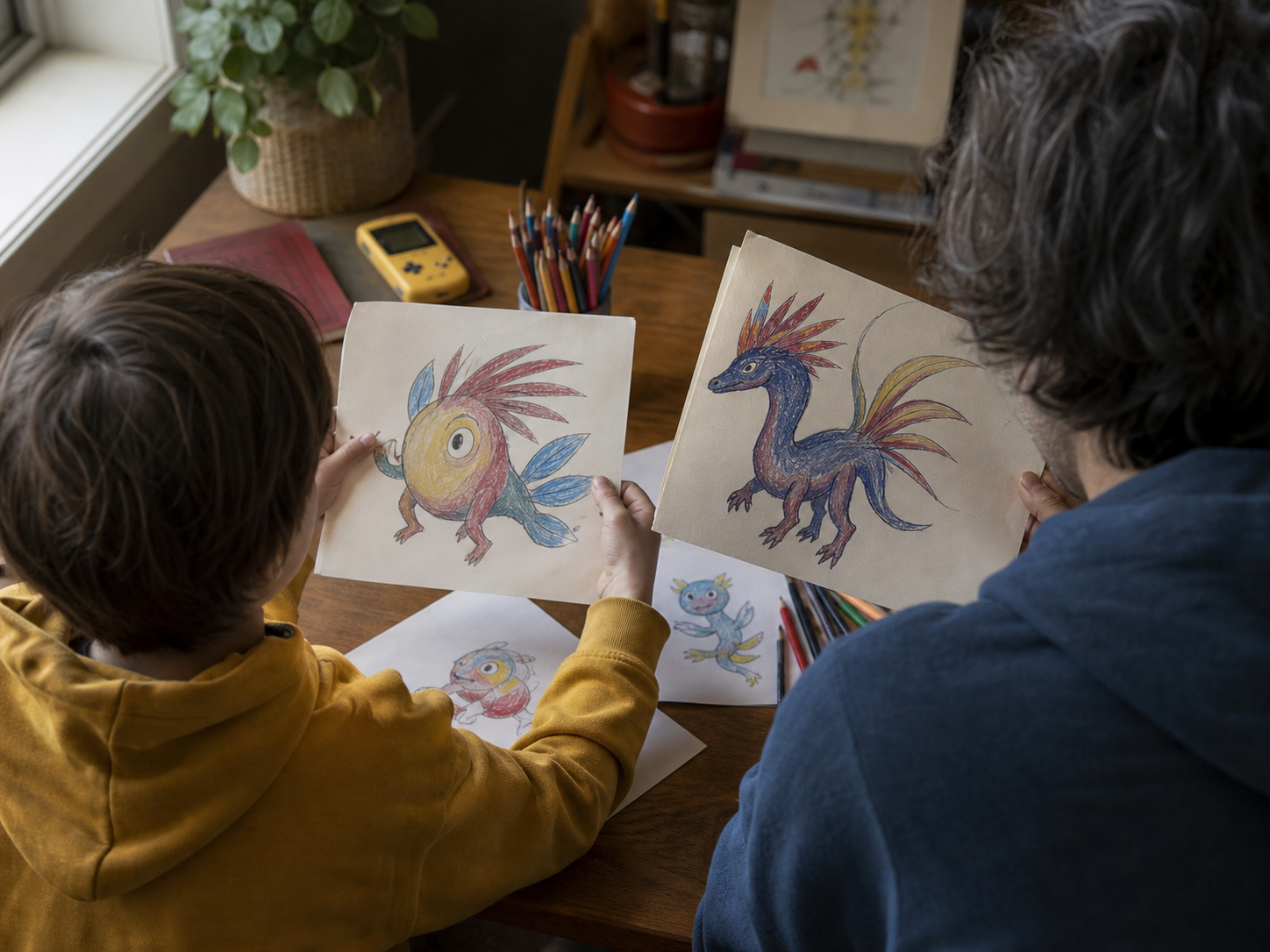
Each of you should choose a favorite Pokémon, without trying to pick the same one. Take two sheets of paper and draw for ten minutes, either from a model or from memory. Then swap papers to add a background, a detail, or a color, without erasing the other person’s work. Finish by giving each scene a verbal title and dating the drawings.
The goal is neither to compare artistic skills nor to decide which generation knows Pokémon best. The point lies in the choices: why this creature, this color, this pose, or this memory? For younger children, a coloring page can replace free drawing. Our article From the Triangle to Pikachu offers additional guidelines for adapting the activity for preschoolers.
Keep the two sheets together. Repeating the exercise a few months later with a different Pokémon creates a small family archive: not an expensive collection, but a record of evolving tastes and artistic expressions.
Pokémon has endured for thirty years because it knows how to adapt to new media without losing its core identity. The drawings make this continuity visible: an adult shares a memory, a child reimagines it, and then each person walks away with a version that no official product could have anticipated. Pokémon’s cultural longevity also lies right there—between two sheets of paper, a few pencils, and a creature chosen together.