In Pokémon, we often focus on types, moves, and evolutions. We talk about the graphics, the capture mechanics, the regions to explore... But one fundamental aspect is often overlooked: the power of music. Not just the soundtracks we hum nostalgically. No—music as a force that shapes the world, as a magical language woven into objects, creatures, and the universe itself.
Since the very first generation, instruments like the Poké Flute or the Azure Flute have been more than just gadgets. They serve a playful purpose, of course, but they also carry powerful symbolic meaning: they awaken, heal, and reveal. In both the anime and the movies, songs soothe enraged Legendaries, melodies reconcile humans and Pokémon, and ancient sounds unlock forgotten sanctuaries. Through these musical objects, Pokémon tells us something else: that sound can heal, connect, and transform—and that it is sometimes more powerful than brute force.
A Note to Break the Silence
It all starts with an obstacle: on the road, a Snorlax is fast asleep, completely unresponsive. The player can’t battle it, go around it, or wake it up with a simple item. The solution? A flute. And not just any flute: the Poké Flute, given by a helpful NPC, which must be activated as a full-fledged instrument. In-game, this triggers a short, familiar, and gentle pentatonic melody. And there goes Snorlax, yawning, stretching… and waking up. The path is clear.
This moment, now a cult classic, is significant. It introduces a surprising idea very early in the game: music can be a key.
Not a gameplay trick, but a true narrative driver.
The item doesn’t heal like a potion or replace a spell. It works through sound. In the Pokémon universe, some problems aren’t solved by force, but by listening and through harmony.
This principle also appears in the anime. In several episodes, the Poké Flute is used to soothe a Pokémon in distress or to defuse an impending conflict. It symbolizes another form of connection —one that involves art, vibration, and memory. Through this very simple item, the series introduces a major theme right from the start: music as a gentle yet real power.
Types of Sacred Sounds: Flutes, Bells, and Others
While the Poké Flute is the best-known “musical object” in Pokémon, it is far from the only one. Across the generations, the game—as well as the anime series and certain movies—has incorporated numerous sound artifacts. What do they have in common? They all produce a unique and meaningful sound that has an effect in the fictional world. These items aren’t just practical; they’re ritualistic.
Starting in the third generation, we encounter glass flutes: blue, red, yellow, black… Each one induces a specific state (sleep, confusion, attraction…) and can be used indefinitely. Their timbre evokes a crystalline sound, almost magical. They are no longer potions in disguise: they have a musical texture, an acoustic identity that reinforces their symbolic function. Music heals, dispels, and clarifies.
But it is with the Azure Flute that the musical instrument takes on an almost divine dimension. Originally intended for Pokémon Diamond and Pearl, it was removed from the final version, deemed “too confusing” by Junichi Masuda. It wasn’t until much later, in Pokémon Legends: Arceus, that it finally appeared in-game. It grants access to the Primordial Chamber, where Arceus, the creator of the universe, awaits. Its melody—three sustained notes—isn’t just for show: it opens a passage between the world of the living and the world of myth.
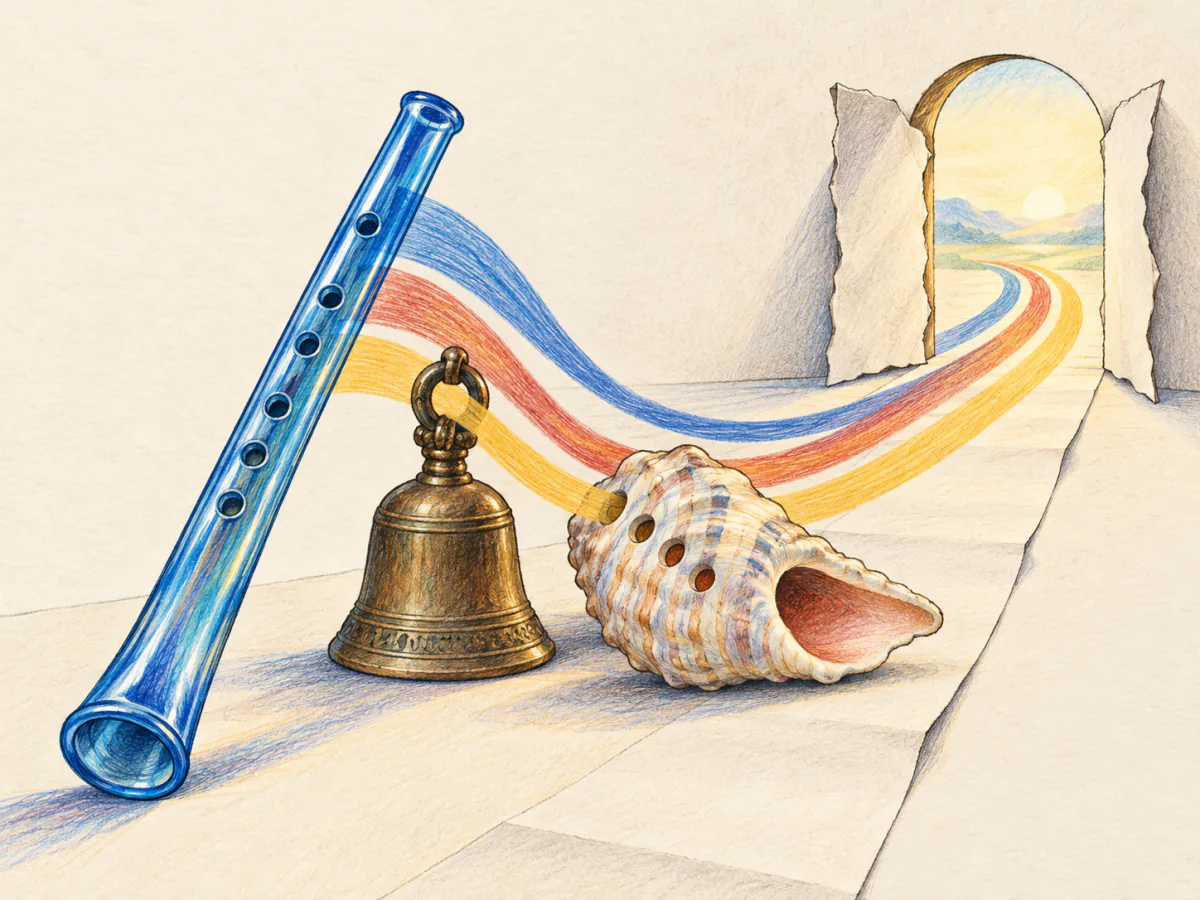
Other lesser-known items also play this auditory role in the expanded Pokémon universe. One example is the sacred bells in the anime, used in certain temples to summon Ho-Oh. Or consider the ancient instruments featured in several movies, such as Pokémon 2000, where the protagonist Melody plays a conch shell flute to calm the legendary birds. In each case, a sound-producing object acts as a bridge between species, between worlds, between dimensions.
These artifacts show that in Pokémon, an object can contain a sound, and that a sound can contain power, a story, and a magical function.
Melodies to Soothe the Gods
Why do these musical objects leave such a lasting impression on us? Because they are not mere tools. They are part of a millennia-old narrative tradition: one in which music is not mere entertainment, but a sacred force. In many cultures, playing an instrument means invoking, healing, and protecting. Pokémon draws heavily on this imagery, sometimes explicitly, sometimes through osmosis.
In Pokémon 2000: The Power Is Within You, young Melody plays an ancient sea flute to soothe the three legendary birds: [Articode(/pokemon/artikodin), Thundurus, and Zekrom. Her melody restores balance to the world**, acting as a balm for the planet itself. In** Lucario and the Mystery of Mew**, a simple song passed down from generation to generation evokes the memory of a lost master. Here again, music becomes** a living memory, a transmission of the soul**.
These scenes echo numerous mythological tales: Orpheus’s lyre capable of charming death, the Pied Piper’s flute leading the children out of the city, or even the ocarinas from the Zelda saga, which open portals, shift time, and summon rain. Pokémon, in its own way, offers its own musical mythology—tailored for children but rooted in the same archetypes.
The music is always ambivalent: both very concrete (it triggers an action) and deeply symbolic (it opens up another level of interpretation). It is a ritual, a spell, a key. And the objects that convey it—flutes, bells, conch shells—are the instruments of an ancient dialogue between humans, Pokémon, and something even greater.
Making the Universe Resonate Instead of Fighting It
In a game where combat is at the heart of the system, the presence of musical objects that act without violence is almost subversive. A flute doesn’t deal damage, doesn’t lower stats, doesn’t capture anything—and yet, it transforms the world.
This paradox lies at the heart of what music represents in Pokémon: a power that doesn’t rely on force, but on vibration.
Take the Azure Flute. In Pokémon Legends: Arceus, using it doesn’t trigger any spectacular effects: it doesn’t strike enemies with lightning, nor does it set off a loud cutscene. It opens. Literally. It opens a passage to the Primordial Chamber, a cosmic sanctuary where Arceus, the creator Pokémon, awaits. Here, music becomes the only possible key. No badge, no battle, no stats are enough. You have to play. And listen.
This principle is also present in the anime and movies, where musical scenes take the place of a confrontation. Think of Melody’s flute in Pokémon 2000, but also of episodes where a simple song sung by a human or a Pokémon is enough to defuse a conflict. The power lies not so much in domination as in restored harmony.
This design choice, rarely highlighted in reviews of the game, is nonetheless one of the most striking. It offers players—children and adults alike—a different way to play: a way in which listening, sensitivity, and rhythm can produce effects as powerful as a Hyper Potion or a super-powerful attack.
The Ears of the World 👂
Musical items in Pokémon don’t just leave a mark in the games or episodes: they resonate in players’ memories, sometimes for years. Their impact goes far beyond their technical function. These are sounds we remember, imitate, and replay—and sometimes even turn into memes or theories.
Take the Azure Flute, for example. Its strange three-note melody has sparked fascination and debate within the community. Why wasn’t this item—despite being so central—activated in the original games? Why is its effect—the opening of a sacred sanctuary—so mysterious? Players have long believed in a hidden event, a forgotten quest, or a code that was never revealed. This ambiguity has helped forge a mythical aura around the item, far beyond its actual presence in the gameplay.
On forums, in YouTube videos, and in fan articles, these items are regularly analyzed, discussed, and reinterpreted. Some imagine new uses for the glass flutes, while others rework their sounds into orchestral or electronic versions. There are even remixes of the Poké Flute or Melody’s Flute from Pokémon 2000, incorporated into live performances.
This collective resonance shows that music—even when contained within a simple in-game object— becomes a shared memory. It is passed on, transformed, and replayed. And above all, it conveys something that statistics or attacks cannot express: the power of emotional sound in a world of numbers and types.
In Pokémon, it often all starts with a capture. But some key moments can’t be caught with a Poké Ball. You listen to them. You feel them resonate. They emerge from a forgotten flute, a sacred bell, or an ancient song thought to be lost.
These musical objects, seemingly unassuming, run throughout the entire saga—from games to movies, from anime to spin-offs—to remind us of something essential: music is a language in its own right, capable of healing, connecting, and bringing things to life.
The Poké Flute doesn’t just induce sleep. It teaches a different way of playing. The Azure Flute does more than just open a room: it opens a connection to the sacred, to silence, to memory. And what fans do with them—remixes, covers, analyses—shows that these musical objects transcend their status as mere in-game items. They become emotional anchors, treasures of memory, bridges to the imagination.
So, the next time a player finds a flute in their bag, a character holds out an instrument to calm a Pokémon, or a familiar cry rings out between two notes… let them listen closely. They may be holding, in their hands, a fragment of the true magic of Pokémon: the kind that doesn’t strike—but resonates.